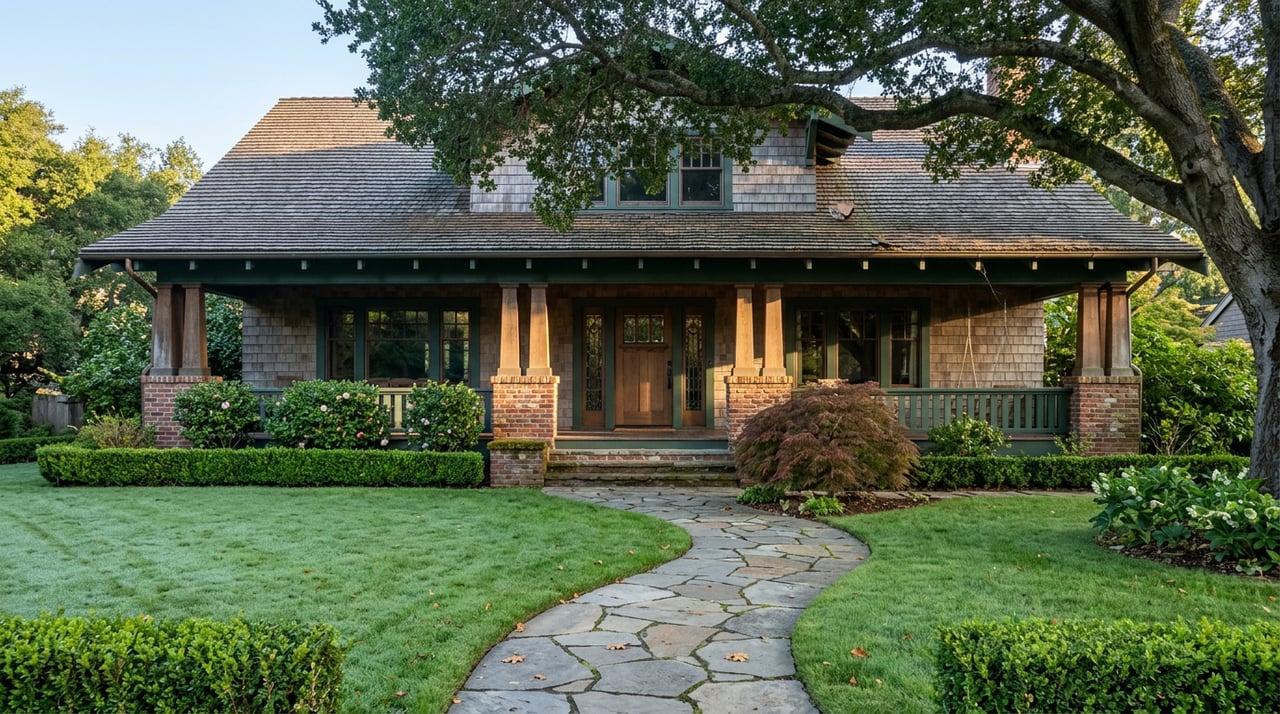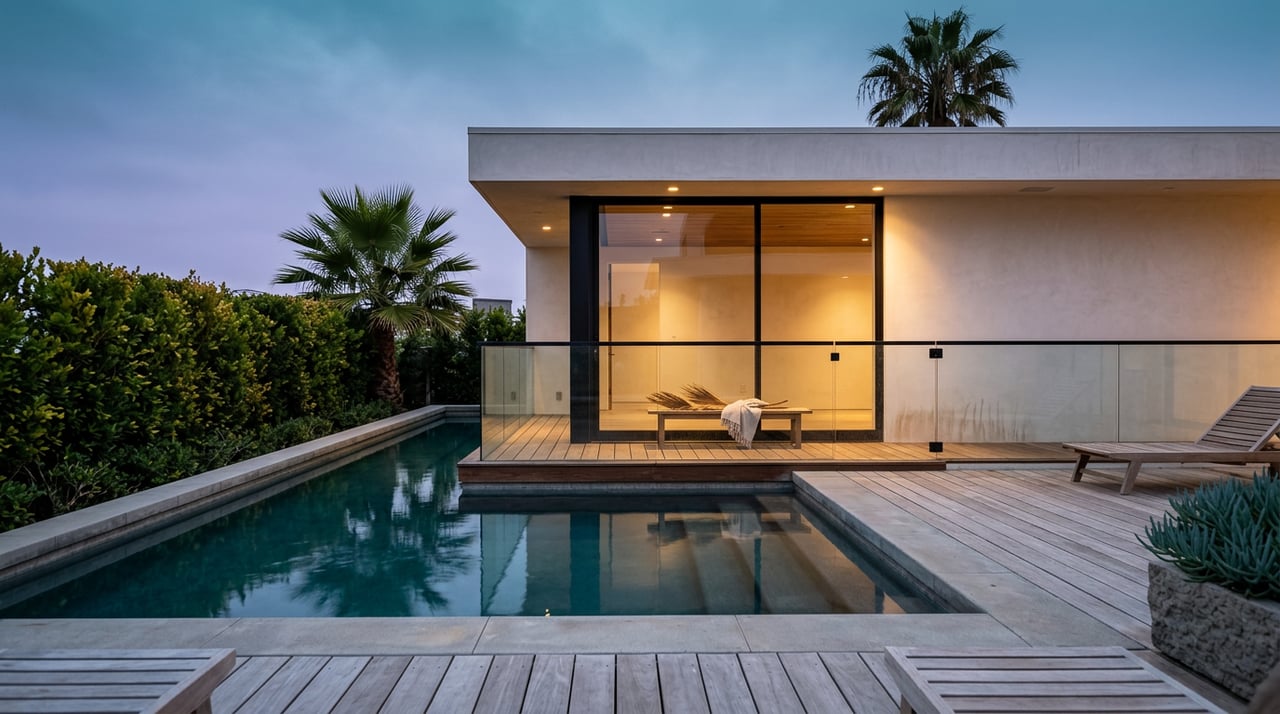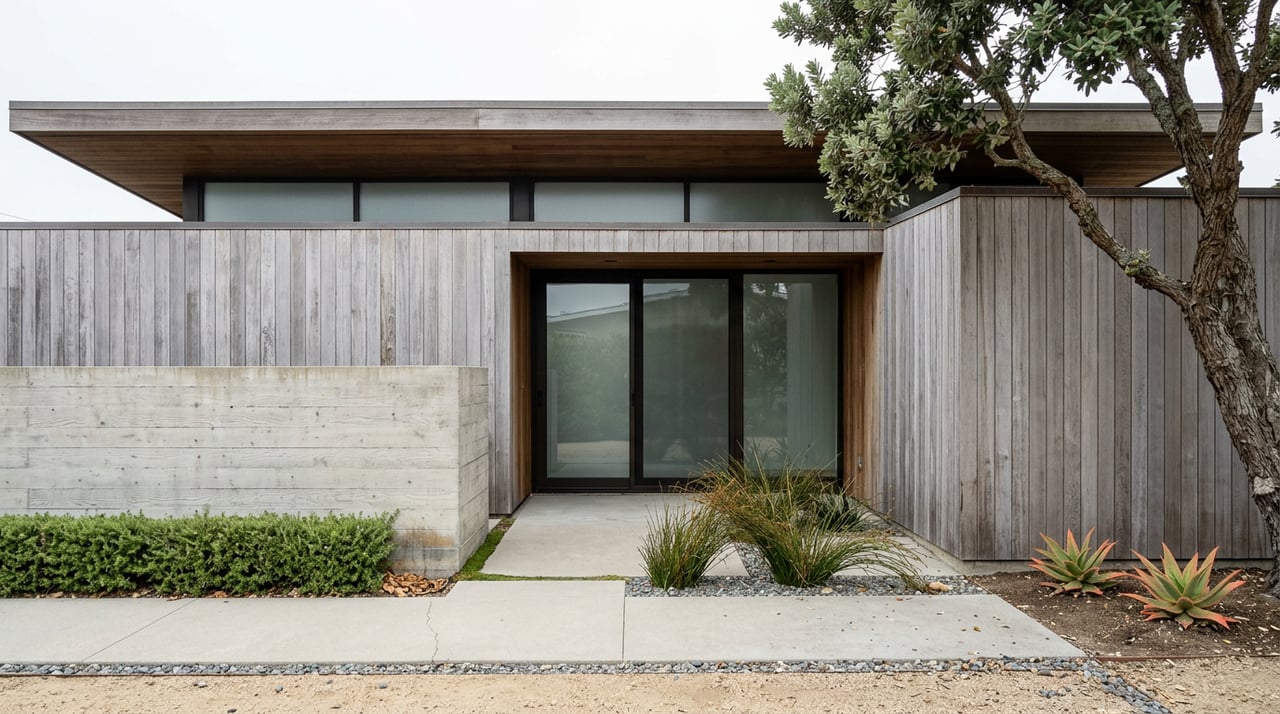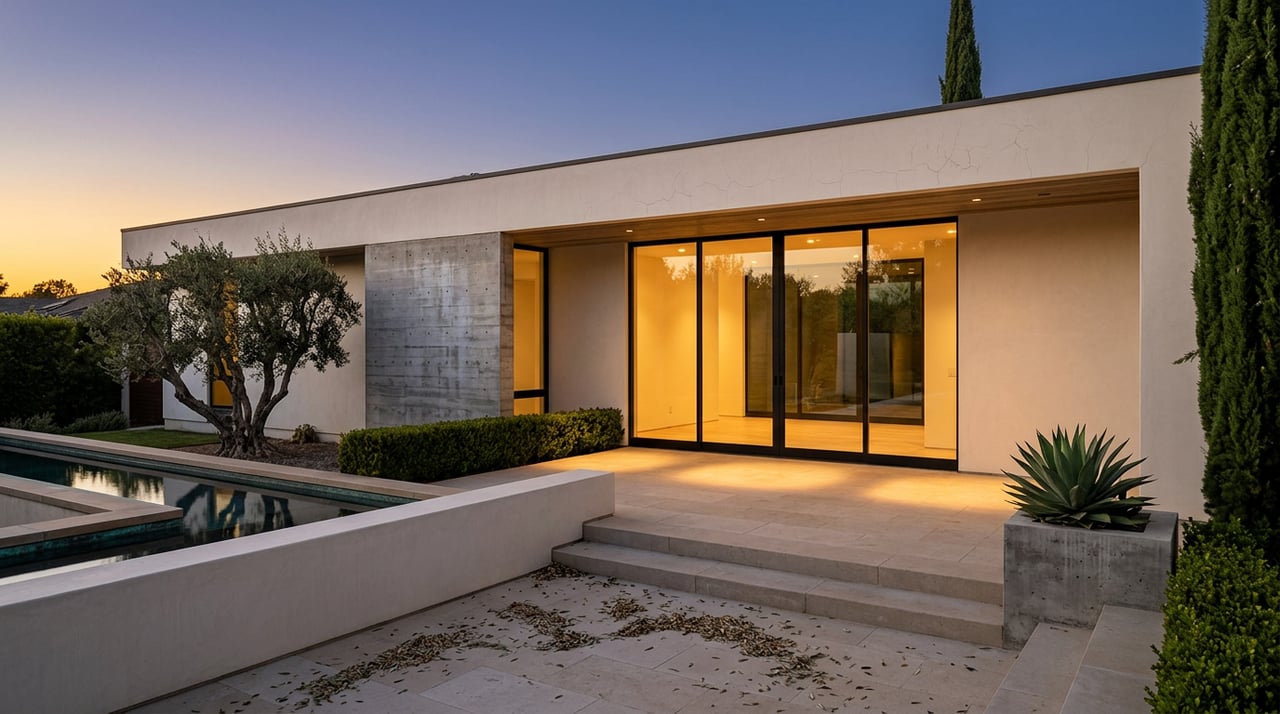
Earlier this year, the Cecil B. DeMille estate at 2000 De Mille Drive went on the market for just under $30 million, the most significant Laughlin Park listing in years. Angelina Jolie had held the property before putting it up for sale, continuing a chain of ownership that runs back through DeMille himself, who bought the hilltop parcel in 1916 and stayed until 1959. It is the kind of listing that makes headlines and gets photographed for glossy spreads.
It is also, by the standards of its own neighborhood, unusual. Most of the homes around it never get photographed at all.
Laughlin Park is a guard-gated enclave of roughly sixty houses tucked into west-central Los Feliz, reached through a single staffed entrance off Los Feliz Boulevard. Homer Laughlin began assembling the hillside in 1890 and platted the original forty home sites by 1913. Decades of lot splits brought the count to today's sixty, spread across four private streets: De Mille Drive, Linwood Drive, Cummings Drive, and Laughlin Park Drive. Architects including Lloyd Wright, Gordon Kaufman, Julia Morgan, and Roland Coate all built here. W.C. Fields lived on De Mille Drive through the 1930s and 40s. Charlie Chaplin leased the house next door to DeMille's from 1918 to 1920. More recently, Natalie Portman and Kristen Stewart have called the enclave home.
None of that history is what makes Laughlin Park worth understanding if you're weighing a Los Feliz purchase or sale in 2026. What matters is that a meaningful share of its transactions never reach a public listing at all, and that fact is quietly becoming true of more of the market above it, not less.
The Math Behind a Closed Gate
When an entire neighborhood is sixty houses, everyone in it tends to know everyone else, along with the handful of agents who serve them. A home doesn't need a yard sign or an open house to find its buyer. It needs a phone call. Some of the highest-value trades in Laughlin Park never have a professional photograph taken. The only images that exist are the ones an agent shoots on a phone and sends to one or two people who were already looking.
The Oaks, the architectural hillside pocket just north, behaves the same way for the same reason: a small, mostly known buyer pool and owners who value the same quiet. Franklin Hills, just south of both, moves differently. It is a larger, more public market where homes sell on the MLS at a faster pace, which means a buyer's strategy has to change depending on which pocket of Los Feliz they're actually chasing.
Here is roughly how the four tiers compared through the middle of 2026, along with how each one typically changes hands.
| Sub-area | Approx. 2026 price band | How it typically sells |
|---|---|---|
| The Village / flats | $1.2M to $2.5M | Public MLS listings, competitive offers |
| Franklin Hills | $1.5M to $4M | Public market, faster pace |
| The Oaks | roughly $2.5M to $8M+ | Mixed, more private sales near the top |
| Laughlin Park | roughly $4M to $12M+, one 2026 listing near $30M | Largely private, agent to agent |
A buyer who searches "Los Feliz homes for sale" and stops at whatever the portals return is seeing the Village and Franklin Hills clearly. They are seeing a fraction of the Oaks and very little of Laughlin Park, not because those homes don't exist, but because a real share of them are never marketed publicly in the first place.
Why an Owner Chooses Silence Over a Sign
Privacy is the obvious reason an owner in these pockets sells quietly. A public listing with photographs and an open house runs against the entire reason someone bought behind a gate in the first place. But there's a second reason that has become sharper in 2026, and it has nothing to do with discretion for its own sake.
Los Angeles' Measure ULA transfer tax now applies at $5.4 million and $10.9 million for transactions closing after June 30, 2026, with a 4 percent tax above the first threshold and 5.5 percent above the second. At a typical Village or Franklin Hills price point, that tax rarely enters the conversation. In Laughlin Park, where the median sale price runs above $7 million, nearly every transaction crosses it. That turns pricing strategy into a six-figure decision that has to be built into the plan from the first conversation, not discovered at escrow. A quiet sale gives an owner and their agent more room to negotiate terms, timing, and structure around that math than a public bidding process typically allows.
Whether going private actually nets a seller more money is genuinely unsettled. A joint study by Bright MLS and Drexel found a 17.5 percent price premium for properties marketed on the open MLS. A separate study out of the University of Georgia found the opposite for pocket sales specifically, a 1.7 percent premium, arguing it came from avoiding the discounting pressure of open-market negotiation rather than from any agency conflict. The honest answer for a Laughlin Park or Oaks seller in 2026 is that privacy, control, and a calmer process are the real, provable benefits. A higher price is not guaranteed either way.
The Industry Just Admitted the Off-Market Layer Is Permanent
Since 2020, the National Association of Realtors' Clear Cooperation Policy has required any publicly marketed listing to hit the MLS within one business day, an attempt to keep pocket listings from becoming a shadow market. The policy is still technically on the books. It is no longer functioning as intended.
In late April 2026, MRED, a Chicago-based MLS, announced a national expansion of its own private listing network. Compass said it would subsidize MRED subscriptions for up to 100,000 of its agents. Days later, Zillow and Realtor.com announced they would begin displaying Zillow's pre-market "Preview" listings on both platforms, giving buyers early access to homes that haven't formally hit the open market. None of this repeals Clear Cooperation. It builds real infrastructure around it, which is a different and more permanent thing.
For a neighborhood like Los Feliz, where the top of the market already ran on relationships more than marketing, this shift doesn't create the off-market layer. It formalizes it. The homes that used to circulate through a handful of personal calls are increasingly moving through structured private networks that a buyer without an agent inside them simply cannot see. That gap is not closing in 2026. It is being built out with more deliberate tools than it had before.
What This Actually Means If You're Comparing Los Feliz to Somewhere Else
If your search is confined to the Village or Franklin Hills, the public numbers you're seeing are close to the whole story. Public listings, competitive offers, and a median that moves in step with what actually sells. That part of Los Feliz behaves the way most buyers expect a market to behave.
Above roughly $3 million, and especially inside Laughlin Park's single gate, the visible market and the real market start to diverge. A published median sale price, wherever you find it quoted this quarter, describes homes that made it to a public record. It says very little about the ones that didn't, and in the pockets where that share is largest, it's also where the homes tend to be the most significant.
That has practical consequences on both sides. A seller in that tier is choosing between two different outcomes, not just two marketing approaches, and the ULA math needs to be part of that choice from day one. A buyer who wants access to that tier needs a relationship in place before a specific address ever comes up, because by the time it would show up in a normal search, in many cases, it already sold.
A Few Questions Worth Asking
Does every high-value Los Feliz sale skip the MLS? No. Franklin Hills and most of the flats still sell through standard public marketing. The private-sale pattern concentrates specifically in Laughlin Park and the upper Oaks.
Does selling privately guarantee a lower price? The research is mixed, and it points the opposite direction as often as not. Privacy, control over showings, and a calmer process are the dependable benefits. Price is a case-by-case outcome.
Does Measure ULA apply to every Los Feliz sale? No. At a citywide median well under $2 million for most of the neighborhood, ULA rarely touches a typical transaction. It becomes relevant almost exclusively at the Oaks and Laughlin Park price points, where the $5.4 million threshold is closer to a starting point than a ceiling.
For homes in this tier, the market that matters is rarely the one showing up in a search bar. If you're trying to understand what's actually available in Los Feliz, or what a home in one of these pockets would bring in a private conversation rather than a public listing, Greg Holcomb and the team work this exact terrain across Los Feliz and the surrounding hillside neighborhoods. Let's connect and start a confidential conversation about what your property, or your search, actually looks like once you're past the median.