On the night of April 7, 2022, at about 9:20, an old western sycamore in Compton fell over. For more than three centuries, eagles and other raptors had nested in its branches. Long before that night it had also served as a line on a map: the northern boundary of Rancho San Pedro, one of California's earliest Spanish land grants, established in 1784.
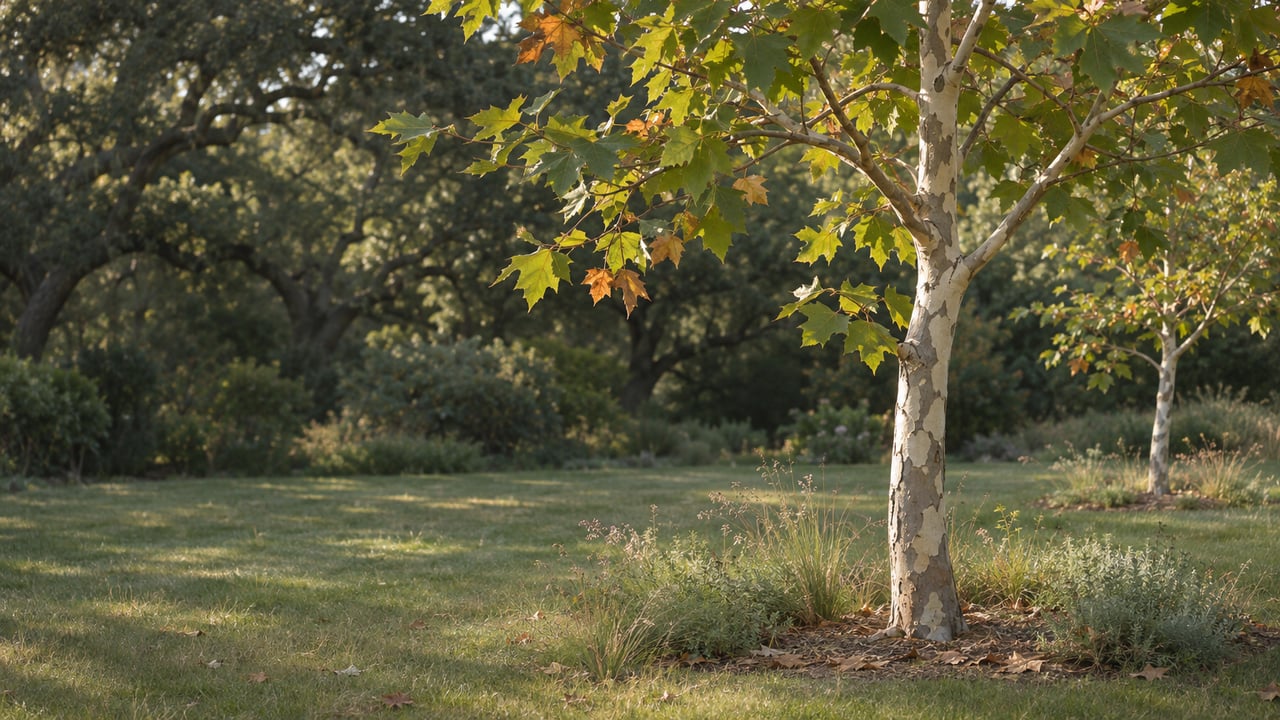
Today two genetically identical descendants of that tree are planted in Oak Meadow, the new garden at The Huntington that links the Virginia Steele Scott Galleries of American Art, the MaryLou and George Boone Gallery, and The Rose Hills Foundation Conservatory for Botanical Science. The meadow opened in June 2026 as the outdoor half of "This Land Is ...," the Boone Gallery exhibition about how land shapes American history. That exhibition closes on Jan. 11, 2027. The meadow has no announced end date, and the two young sycamores are the clearest sign of what the whole project leaves behind on the grounds.
A survey point with leaves
The Eagle Tree was famous mostly for where it stood. Henry Hancock's 1857 survey of Rancho San Pedro recorded it as the "Place of Beginning," and in April 1947 a plaque was installed to mark its historic importance. In 1987 the Los Angeles Times described it as the northern boundary marker of the rancho and a survey point tied to an 1858 land decree signed by President Buchanan.
The tree's leaves had largely stopped coming out around 2017, according to the historians who later led the effort to save its genes. After it fell, cranes moved its seven-ton trunk so it could be preserved. A tree that had settled property lines since the rancho era ended up as a salvage job.
From an ice chest to the meadow
The tree survives as a living plant because Kim Cooper and Richard Schave, founders of the tour company Esotouric, organized a rescue of its genetic material. Working with environmental horticulturist Donald R. Hodel, they brought in The Huntington, the California Botanic Garden and the Theodore Payne Foundation to collect and propagate cuttings. Alta reported that 100 cuttings were taken and divided among the three institutions before the young growth at the site was cleared.
In a July 30, 2026 post, the founders described the method. Fresh twigs went into wet towels and then an ice chest before they were handed to the botanists. The founders later checked on stubby clones in The Huntington's nursery and on tiny ones growing in jars in its Plant Tissue Culture and Cryopreservation Lab. They also wrote that staff asked them, almost as an aside, whether they wanted to see where the bigger clones had been planted.
The Huntington does similar lab work with its oaks. Oaks are among the 8 to 15 percent of plant species whose seeds cannot survive drying or freezing, so acorns cannot go into an ordinary seed bank. Huntington staff work with about 15 oak species in the cryobiotechnology lab, using cryopreservation and micropropagation to keep them going.
Not every clone has done as well. The first Eagle Tree sapling was planted at East Los Angeles College on Earth Day 2024, and Esotouric later reported that it failed to thrive. The founders say more small trees are waiting to be hardened off and planted at historic sites around Southern California. For now, the two sycamores in Oak Meadow are the descendants a visitor can walk up to.
What the rest of the meadow is built from
The sycamores fit a pattern. Most of what is planted in Oak Meadow arrived with some piece of California land history attached, and The Huntington's own plant notes tell those stories.
- Engelmann oak. It grows naturally only in California and Baja California. Its range centers on San Diego County, and Pasadena has one of the smaller populations, which makes it a local tree for this side of the San Gabriels.
- Coast live oak and valley oak. Together with the Engelmann, these anchor the shaded lawn and the expanded paths.
- Toyon. California holly is the official native shrub of Los Angeles. The Huntington notes that the popular story tying it to the name Hollywood is incorrect.
- California grape. When an invasive pest destroyed European vineyards between 1870 and 1900, European grapes were grafted onto resistant North American rootstocks, including this one. Growers still value it for disease resistance.
- Purple needle grass. It is California's state grass, its deep roots hold up through drought and fire, and a single plant can live as long as 200 years.
By The Huntington's count, the meadow has more than 5,000 plants, about 55 species, 22 newly planted trees and 16 oaks. That last figure counts individual trees, including oaks that were already growing on the site. Across the whole property, The Huntington holds 85 oak species and 885 oak trees, some as old as the country or older. Even the furniture continues the theme. The benches are made from wood salvaged from garden trees that fell in storms.
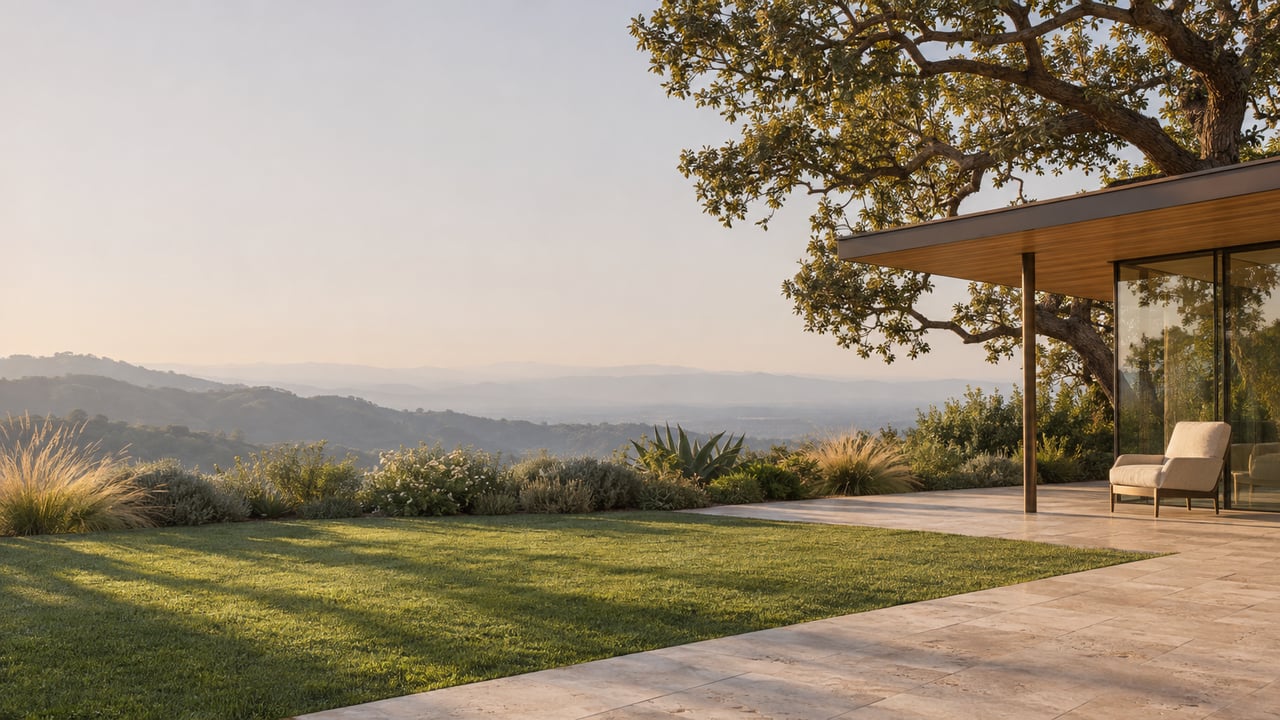
At the opening reception in June, Library Director Sandra Brooke Gordon called the meadow's mountain view "one of the most beautiful views in America," according to Hey SoCal. Landscape Architecture Magazine described the project as a reimagining of The Huntington's lawn around natives, climate-adapted species and oaks.
Indoors, the same trees as artifacts
The exhibition in the Boone Gallery makes the same argument with objects. According to the Los Angeles Times, it opens with a cross-section of a Pasadena oak roughly 250 years old. Time Out gave the show four stars out of five and named that slice of trunk its most humbling object. The exhibition also includes a slab from an Engelmann oak that grew in front of the Library until a storm brought it down on Jan. 17, 1993. Inside, the oaks are relics. Outside, young Engelmanns are growing about a short walk from where the old one stood.
The exhibition's highlights also include Woody Guthrie's 1936 guitar inscribed "This Machine Kills Fascists," annotated July 1776 printings of the Declaration of Independence, and family materials from Japanese American flower farmers in Los Angeles. Hey SoCal reported that the galleries are arranged in six sections: roots, uprootings, amendments, edge effects, disturbances and regeneration.
The last of those sections continues outside. A boundary tree that was fenced, felled and almost lost now grows in a public meadow as two clones. The wider "This Land Is ..." initiative continues through 2027, and the reimagined American art galleries next door are scheduled to stay on view through Nov. 20, 2036.
Seeing both before Jan. 11
The meadow and the exhibition are next to each other, so one visit covers both, and the remaining weeks include two peak seasons and four closure days. Here is the calendar as The Huntington publishes it:
| Date | What it means for a visit |
|---|---|
| Nov. 20 | Holiday Market Preview in Haaga Hall, for Affiliate-level members and above |
| Nov. 21 | Huntington Holiday Market, free and open to the public, limited capacity |
| Nov. 20–29 | Thanksgiving peak season, reservations required |
| Nov. 26 | Closed for Thanksgiving |
| Dec. 3 | Free Day, advance reservation required |
| Dec. 18–Jan. 3 | Winter holidays peak season, reservations required |
| Dec. 22 and Dec. 29 | Open on these two Tuesdays, normally a closed day |
| Dec. 24, Dec. 25, Jan. 1 | Closed |
| Jan. 7 | Free Day, the last one before the exhibition closes |
| Jan. 11 | Final day of "This Land Is ..." |
The Huntington is normally open 10 a.m. to 5 p.m., Wednesday through Monday, and closed Tuesdays. Adult admission is $29 Monday through Thursday and $34 Friday through Sunday, on holidays and during peak seasons. Reservations are required on those higher-priced days, and the ticket time is the earliest you can arrive, not a fixed entry slot. Free Day tickets are released at 9 a.m. on the last Thursday of the month before. Each household can get five per year, members cannot use them, and every guest needs a ticket, including infants. The page is updated regularly, so check it the week you plan to go.
A Monday-through-Thursday visit outside the peak weeks is the calmest choice, and the gardens around the meadow are in season. Camellias are blooming through the Chinese Garden, the Japanese Garden and the North Vista. Agaves in the Desert Garden are sending up flower stalks that can reach 30 feet. The aloe season is listed as starting Nov. 15. The rotating orchid display has been running in the Rose Hills Foundation Conservatory, at the meadow's edge, since Nov. 5. Walk through the Boone Gallery first, then go out to the sycamores.
Provenance applies to trees as much as to houses. When the oaks or sycamores on a San Marino or Pasadena lot are older than the house, a sale is a chance to put their history on the record. If your property has history worth carrying forward, The Greg Holcomb Group would welcome a confidential conversation about how to present it.